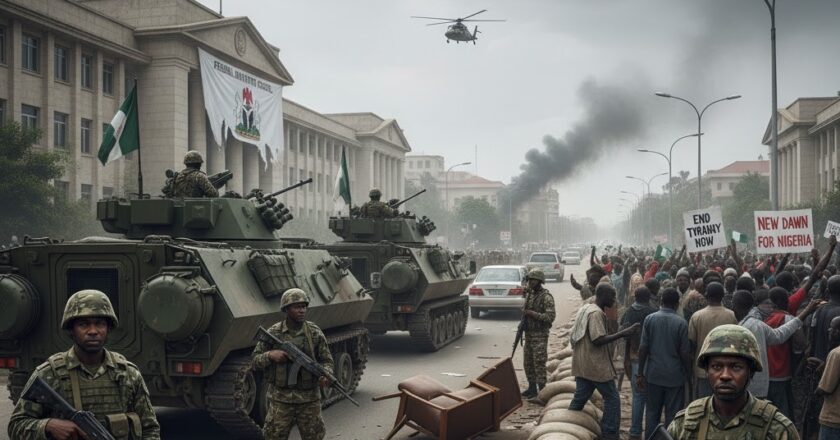
In the run-up to the October 1st Independence celebrations, Sahara Reporters leaked a story that a bloody coup aimed at destabilizing, and overthrowing, the democratic government of President Tinubu had been thwarted.
There is still no official confirmation of this till date even though top service chiefs have been replaced and more than 40 officers have been arrested by the DSS who allegedly have had them under surveillance since August 2024.
Nigeria is a different country to the way it was in the 60s, 70s and 80s when anybody, presumably any disgruntled junior officer, could just pick up a gun, overthrow the incumbents, become Head of State and start their dictatorships: Africa, and mostly certainly Nigeria, have moved on from the Abachas and Idi-Amins of the past.
A military junta coming into power will abolish all laws and will rule by degree, so it’ll be a question of them shouting ‘jump’ and the people going ‘how high?’. Nigerians have long evolved beyond this and it’ll only bring out the people, en-masse, to protest. And as we’ve seen from previous mass protests, such as #ENDSARS, it’s not easy to crush the will of the people anymore. No more are they scared of a soldier with a gun. And with social media to pass the word around and keep everyone up to date; a medium even the junta can’t control or shut down completely, as we’ve seen when the Buhari-led government tried shutting down Twitter usage in Nigeria, people just used VPNs to get around the ban. So, a government overall control of the media is out of the question.
Nigerians have tasted the freedom of democracy, however imperfect it may be, and a return to a repressive military will not be welcomed with open arms: people now have the right to elect whoever they want to rule them instead of having somebody imposed upon them.
For a military coup to be successful, the military will have to coral the people into a pen they can control: this can work in countries like Mali or Niger where the entire populace is less than the population of Lagos state. In Nigeria, a country of more than 200 million souls plus, the military is already stretched beyond its limits fighting insurgencies in the North and South-East so a new military junta won’t have the might – or equipment – to control the country successfully.
Mali and Niger armed forces removed democratically elected Presidents and their governments on the grounds of absolute abuse of office. Some will argue that the same should happen in Nigeria.
Whilst I’m not a big fan of President Tinubu, it’s got to be said he’s been in power for less than two years and he inherited a mess from Buhari who in turn inherited it from Jonathan, who….need I go back any further? Logically thinking, anybody coming into power, military or civilian, will not have the power to change things overnight, as the people want, and the hardship will continue. For those old enough to remember when the Buhari/Idiagbon junta ousted Shehu Shagari from power in 1983 change did not happen overnight: it was a gradual undertaking and things weren’t as bad as they are now. So a military junta coming in will just huff and puff without getting anything done .And to make matters worse, the international community will be watching and will impose extremely tough sanctions upon the nation, in effect crippling all business transactions in and out of the country. And if they go as far as declaring an oil embargo and call in all loans obtained, the country will be finished.
Furthermore ECOWAS, the OAU – including President Trump’s USA – may decide on a military intervention to forcibly remove the junta from power because democracy cannot be seen to fail in Nigeria, Africa’s most populous nation, as it has in Mali, Niger and elsewhere.( – and don’t forget Trump is looking for any excuse to bomb ‘disgraced’ Nigeria anyway!). If people think life under Tinubu is hard, then it’ll become unbearable.
In an earlier article (“Are Coups in Africa still a Good thing?) I did point out that if we are going to practice democracy the African way, there should be provision to remove inept and corrupt leaders the African way (aka a coup d’état). Without sounding like I’m contradicting myself, people like the late Robert Mugabe needed a palace coup to remove him from office (- as may well Paul Biya of Cameroon) for the systematic abuse of the democratic process that kept him in power. The same can be said also of the autocratic democracies of Niger, Mali etc who were also overthrown by the military. But the question is, as I pointed out then, is where do you draw the line?
Nigeria is still a fledgling democracy, I say it is still in its infancy, and mistakes will be made as we learn as once did the great democracies of the Western world: we are going to screw things up, abuse things but eventually we’ll get it right (whenever that might be!) as they say Rome wasn’t built in a day. Allowing the boys in khaki back will just send us back to square one and all the efforts of those who fought for modern-day democracy in Nigeria, like MKO, would have been in vain.
So the idea that a semi-illiterate gun-toting ‘who-build-dis-garda’ Army General seizes power and miraculously restores the country to its former glory, overnight, is not going to happen. It’s simply against the Law of Averages.
Follow Tony on Twitter: @Archangel641 or visit http://www.archangel641.blogspot.co.uk